Visit BlogAdda.com to discover Indian blogs Visit blogadda.com to discover Indian blogs | Training Institute in Pune

Tuesday, 21 March 2023

Machine Learning Algorithms For Data Science

Machine learning is an important part of data science. It is a field of artificial intelligence that involves developing algorithms and statistical models that allow computer systems to improve their performance on a task through experience. Machine learning is used in data science to analyze large volumes of data, data extraction, and make predictions based on the data.

In data science, machine learning is used to build predictive models that can be used to identify patterns and trends in data. These models can be used to make predictions about future events, such as customer behavior, financial trends, or the outcome of a sporting event. Machine learning can also be used to automate tasks, such as an image or speech recognition.

Some of the most popular machine learning techniques used in data science include regression analysis, decision trees, random forests, support vector machines, and neural networks. These techniques can be used to solve a wide range of problems in data science, including classification, regression, clustering, and anomaly detection.


Why Learn Machine Learning With Data Science


To be a successful data scientist, you must have a strong understanding of machine learning techniques and algorithms. By learning machine learning with data science you will be better equipped to analyze large datasets and extract valuable insights from them.


Machine learning can be used to build predictive models that can be used to make predictions about future events. In data science, predictive modeling is used to identify trends and patterns in data, which can help businesses make more informed decisions.


As we all know Machine learning is becoming increasingly popular in the business world, and companies that use machine learning to gain insights from their data are gaining a competitive advantage. As a data scientist, learning machine learning techniques will make you more marketable and give you an edge in the job market.


According to AmbitionBox, the average annual salary for Data Scientists and Machine Learning Engineers in India is ₹10.0 Lakhs, with a salary range of ₹4.0 Lakhs to ₹38.7 Lakhs. This estimate is based on the latest salary information from 204 individuals in these roles.


Learning data science with machine learning is highly beneficial Because you can gain a comprehensive understanding of how to analyze large data sets and develop predictive models. This combination can be particularly powerful in solving real-world problems, as data scientists often use machine learning to make predictions and generate insights that can be applied in various fields, such as healthcare, finance, and business. 


And the best part is many of the most in-demand job roles in the data science field, such as Data Scientist, Machine Learning Engineer, and AI Researcher, require expertise in both data science and machine learning. By learning both, you can expand your skillset and become a more competitive job candidate.


Basically, learning data science with machine learning can help you to develop a strong foundation in data analysis and predictive modeling, and open up a range of exciting career opportunities.


If You are Interested in Learning Data Science With Machine Learning Click Here For More Details.

Saturday, 18 March 2023

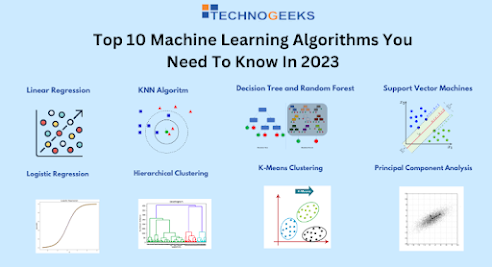
Top 10 Machine Learning Algorithms You Need To Know In 2023


In our rapidly advancing technological world, the definition of manual labor is evolving as nearly all manual tasks are being automated. Machine learning algorithms are a major contributor to this evolution, enabling computers to play chess, perform surgeries, and become more intelligent and personalized.

As computing has progressed over the years, we can anticipate even more advancements in the future. One notable aspect of this technological revolution is the democratization of computing tools and techniques. 

Machine learning algorithms have been developed in response to the need to solve complex, real-world problems. These algorithms are automated and self-modifying, allowing them to continually improve over time. 

Let’s Discuss the top 10 Machine Learning Algorithms 

1. Linear Regression: It is a simple and widely-used algorithm that is used to model the relationship between a dependent variable and one or more independent variables.

2. Logistic Regression: It is a statistical method used to analyze a dataset in which there are one or more independent variables that determine an outcome. It is commonly used for binary classification problems.

3. Decision Tree: It is a simple but powerful machine learning algorithm used for both classification and regression problems. It works by dividing the dataset into smaller and smaller subsets based on the features in the dataset.

4. Random Forest: It is an ensemble learning method that combines multiple decision trees to improve the accuracy and stability of the model.

5. Support Vector Machines (SVM): It is a powerful algorithm that is used for both classification and regression tasks. It works by finding the hyperplane that maximally separates the classes in the dataset.

6. K-Nearest Neighbors (KNN): It is a non-parametric algorithm that is used for classification and regression tasks. It works by finding the k-nearest neighbors to a given data point, and using their labels to predict the label of the data point.

7. Naive Bayes: It is a probabilistic algorithm used for classification tasks. It works by calculating the probability of each class given the data and choosing the class with the highest probability.

8. Gradient Boosting: It is a machine learning technique that builds an ensemble of decision trees and iteratively improves the model by adding new trees that correct the errors of the previous trees.

9. Neural Networks: It is a powerful and flexible machine learning technique inspired by the structure and function of the human brain. It is used for both classification and regression tasks.

10. Convolutional Neural Networks (CNN): It is a specialized type of neural network that is designed to work with image data. It uses convolutional layers to extract features from the images, and pooling layers to reduce the dimensionality of the features.

Future Of Machine Learning


The future of machine learning is promising with continued growth and adoption, advancements in deep learning, increased use of reinforcement learning, the rise of Explainable AI, and the incorporation of ML into edge computing and IoT devices.


Technogeeks is an excellent learning platform for mastering Data Science With Machine Learning.

Enroll to kickstart your journey in Data Science.

Checkout our course on Data Science below

👉 https://technogeekscs.com/courses/data-science-training-classes-institutes-in-pune 👈

Friday, 17 March 2023

How To Become Azure Data Engineer


Who is an Azure Data Engineer?


An Azure Data Engineer is a professional who designs, develops and manages data storage, data processing using Microsoft Azure Technologies. The primary responsibility of an azure data engineer is building and maintaining data pipelines, data warehouses, and data lakes, as well as implementing data security and governance measures. Also, Azure Data Engineer Works With data architects, data scientists, and other members of the data team to build and manage data solutions that enable data-driven decision-making.

Why Choose Azure Data Engineer?

As we all know Azure Data Engineering is one of the most trending and fastest-growing technologies on the market today because of the tremendous growth of Azure Cloud technology.


There are many reasons why companies hire Azure Data Engineers and why someone might choose to pursue a career as an Azure Data Engineer.

  1. High demand: The need for data engineers is increasing rapidly as more organizations want to use their data effectively. According to a report by the US Bureau of Labor Statistics, employment in computer and information technology occupations (which includes data engineering) is projected to grow 11% from 2019 to 2029, much faster than the average for all occupations.
  2. Earning a lucrative salary: According to Glassdoor, the national average salary of azure data engineers in India is around ₹7,62,048.
  3. Azure is a popular cloud platform: Azure is one of the most popular cloud platforms today. As an Azure Data Engineer, you can work on powerful services to help you build scalable and reliable data solutions such as Azure Data Storage, Data Factory, Azure Synapse Analytics, How to Optimize Data Queries in Azure, Azure Databricks, and many more
  4. Exciting and challenging work: As an Azure Data Engineer, you would have the opportunity to work on some of the most exciting and challenging data projects in the industry. Your responsibilities would include designing and implementing data solutions that can help organizations gain valuable insights and drive positive business outcomes. As data is becoming an increasingly important aspect of business operations, the role of a data engineer has become more important than ever. Therefore, your work as an Azure Data Engineer would be highly impactful, as you would play a crucial role in ensuring that organizations are able to leverage their data to make informed decisions and drive growth.
  5. Professional development: The field of data engineering is constantly evolving, with new tools and technologies emerging all the time. As an Azure Data Engineer, you would have the opportunity to continuously learn and grow, staying up to date with the latest trends and technologies in the field.

How to Become an Azure Data Engineer?

Qualification needed for Azure Data Engineering

To become an Azure Data Engineer, there is no specific degree or formal education requirement, but having the following skills and qualifications can be beneficial:

  1. Knowledge of cloud computing and Azure services.

  2. Proficiency in programming languages such as Python and SQL.

  3. Familiarity with Azure data storage and processing services.

  4. Experience with data visualization tools.

  5. Practical experience through projects or internships.

  6. Continual learning and staying up-to-date with the latest trends and technologies.


How long does it take to become a data engineer?

If you have a strong background in programming and data management, you may be able to pick up the skills and knowledge necessary to become an Azure Data Engineer more quickly. 


Technogeeks provides an Azure Data Engineering course for max 2 months with Hands-on projects, certificates, best mentorships, providing career opportunities, and so on.

As more businesses worldwide adopt cloud technologies, there is a growing need for data engineering professionals who can help them build and manage data solutions on the cloud. This creates a global demand for Azure Data Engineers, making it an excellent career choice with promising growth prospects.


Interested In Learning Azure Data Engineer Technogeeks is the best place to learn. Technogeeks’ Azure Data Engineer Certification Course is designed to help IT professionals, beginners and data engineers gain experience in designing, building, and managing data solutions using Microsoft Azure services. With Technogeeks, you can learn from industry experts and gain hands-on experience working with real-time projects.

Monday, 27 February 2023

What Is IT Training Institute


An IT training institute is a professional learning center that provides various courses and training programs in information technology (IT) to freshers and working professionals. These institutes offer courses ranging from basic computer skills to advanced programming and networking skills so that even non-IT background candidates can understand the concepts.

In today's world, where technology constantly evolves, the demand for skilled IT professionals has increased significantly. Many IT training institutes have emerged to meet this demand, providing high-quality training programs to students and professionals. These institutes are equipped with the latest technology, tools, and software to provide hands-on training to their students.

IT training institutes offer courses to help students acquire practical skills and knowledge to apply in real-world situations. The course curriculum is designed by working professionals with the latest industry trends and requirements. The courses are also flexible, allowing students to choose the course that best suits their needs and schedule.

Besides providing technical skills, IT training institutes also focus on developing other essential skills such as problem-solving, communication, teamwork, and leadership. These skills are crucial for success in the IT industry, where collaboration and effective communication are vital.

In conclusion, IT training institutes play an important role in shaping the careers of aspiring IT professionals and upskilling existing ones. With the increasing demand for skilled IT professionals, these institutes provide a platform for individuals and organizations to acquire the necessary skills and knowledge to succeed in the ever-evolving IT industry.

Friday, 24 February 2023

How AWS Lambda Works

 Before understanding “How AWS Lambda Works?” let’s first understand “What is AWS Lambda?”

AWS Lambda is a computing service that runs code without installation or managing servers. It was launched in 2014 and since then, it has seen tremendous growth in popularity.

AWS Lambda makes it easy to build, deploy, and manage applications without worrying about the underlying infrastructure required to support them.AWS Lambda Support Programming Languages such as Node.js, Python, Java, C#, and Go.

How does AWS Lambda Works?

AWS Lambda runs code in response to events and automatically manages the compute resources. It can be used in various ways, including as a trigger for other AWS services.

AWS Lambda is a pay-as-you-go service, so you only pay for what you use. You are charged based on the number of requests for your functions as well as the time it takes for your code to execute.


File Processing In AWS Lambda 

A file processing service in AWS Lambda is a function that performs a task on a file. It can be used to process images, videos, PDFs, and other types of files.

A file processing service in AWS Lambda can help you save time and money by performing tasks that would otherwise take hours or days with your own resources.

Stream Processing In AWS Lambda

Stream Processing service provides a way to process data in real time. It allows the system to process streams of data continuously. It can be used for various purposes such as data analytics, machine learning, and IoT.

It is used in many organizations such as Netflix, Twitter, and Amazon. Also, it is used with Amazon Kinesis for applications - activity tracking, transaction order processing, clickstream analysis, data purification, log filtering, indexing, social media analysis, IoT device data telemetry, and metering.


Web Applications In AWS Lambda :- 

Serverless architecture built on AWS Lambda is a new way of building and deploying web applications.In this architecture, there is no need for an application to be deployed on a server before it can be accessed from the internet.

This makes it possible for developers to build their applications without worrying about hosting or scaling their application.Lambda can be integrated with other AWS services to build powerful web applications that are highly scalable.

IOT Backends In AWS Lambda

IOT development has been made easy by AWS Lambda functions that can be used for backend development. 

These functions are perfect for creating IoT backends as they allow developers to write code in a serverless way. Build serverless backends using AWS Lambda to handle web, mobile, Internet of Things (IoT), and third-party API requests.

As we all know, AWS is the market leader in cloud computing, and its market share is only increasing. As more and more businesses move their operations to the cloud, there is a growing demand for professionals with AWS skills and certifications.


Learning AWS cloud computing can open up new career opportunities and help you advance in your current career.


Interested in learning AWS Cloud Computing Click Here For More Details.


Thursday, 23 February 2023

Comparison Between Docker and Kubernetes

 Docker and Kubernetes are powerful tools for DevOps, Docker is a tool used to create, deploy, and run applications using containers. It makes it easy to deploy and run applications in a repeatable and secure manner while Kubernetes is a free and open-source tool that helps automate the management of containerized applications. With Kubernetes, you can easily deploy, scale, and manage your applications without the need for manual intervention. This saves time and effort, allowing you to focus on developing your application instead of worrying about the infrastructure.


So let’s Understand What is the difference between Docker and Kubernetes 


Docker and Kubernetes are both tools used for containerization, but they serve different purposes. Docker is a platform for creating and managing containers, which are lightweight and portable software packages that contain everything an application needs to run, including code, libraries, and system tools. Kubernetes, on the other hand, is a container orchestration platform that automates the deployment, scaling, and management of containerized applications.


Docker provides a way to package an application and its dependencies into a container image that can run consistently across different environments. It also provides tools for building, pushing, and pulling container images to and from container registries. Docker makes it easy to create and manage container images, but it does not offer any native features for orchestration.


Kubernetes, on the other hand, provides a way to deploy and manage containerized applications at scale. It automates tasks such as scheduling containers across a cluster of machines, scaling applications based on demand, and rolling out updates and rollbacks. Kubernetes provides features such as load balancing, service discovery, and automatic container placement, which make it easier to manage containerized applications in production.


In summary, Docker is a platform for creating and managing container images, while Kubernetes is a platform for deploying, scaling, and managing containerized applications. While they are often used together, they serve different purposes in the containerization landscape.


Interested In Learning DevOps? Click here to learn


Thursday, 16 February 2023

Software Testing Course In Pune

 Software testing is the process of detecting bugs & errors in the code and testing software. Testing is important to have a good quality product provided to the client so that's called software testing. It also helps to identify errors, gaps & missing requirements. 


Software testing is divided into two steps-

Verification: “Are we building the product right?” 

Validation: “Are we building the right product?” 


As software continues to play an important role in every industry, there is a high demand for software testers who can ensure that the software is functioning properly and meeting the needs of end-users. Software testing is a dynamic field that requires continuous learning to keep up with the latest tools, technologies, and testing methodologies. This means that software testers have opportunities for professional development and personal growth.


Interested in starting a career in software testing? Our Software Testing Course In Pune is the best place to learn. These courses will teach you all you need to know about software testing skills. The course starts from the basics where you will start from scratch. In the software testing course, you will learn manual testing and selenium automation testing with java.


Software testing is not a dead-end career. With experience and training, software testers can move up the career ladder to become test managers, quality assurance leads, or software development managers.


While Learning Software Testing one question always arises in our mind: What Is Bug In Software Testing?


Types Of Bugs In Software Testing :


Functional bugs: These are bugs that prevent the software from functioning as it is intended. For example, a button that is supposed to submit a form may not work or a menu item may not navigate to the correct page.


Performance bugs: These are bugs that affect the performance of the software, such as slow response times.


Usability bugs: These are bugs that impact the user experience of the software. Such as a poorly designed user interface, confusing or misleading instructions, or poor accessibility features.


Compatibility bugs: These are bugs that occur when the software does not work correctly with certain hardware or software configurations. For example, the software may not work on a particular version of an operating system or may not be compatible with a specific browser.


Security bugs: These are bugs that can lead to security vulnerabilities, such as unauthorized access, data breaches, or denial of service attacks.


Installation bugs: These are bugs that occur during the installation process, such as incorrect or missing dependencies or conflicts with other software on the system.


For Detail Information about Software Testing you can check out my blog post What Is Software Testing?